Navigating Jeju Island Using the Public Intercity Bus System
Use the red express buses from Jeju City Bus Terminal to reach Seogwipo and the coasts without a rental car, saving money with the T-money card and real-time arrival apps.
Getting Around Jeju by Bus the Intercity Network That Works Better Than a Rental Car
The 201 circular bus pulls into Jeju City Bus Terminal at 08:14, right on the time shown on the KakaoMap screen you are holding. You tap your T-money card, the reader blinks green, and the rest of your day on Jeju Island costs you 1,200 won. This is the bus system that makes a rental car an expensive backup, not a necessity.
The Jeju intercity bus network is built around a simple principle: get you from the terminal in Jeju City to the terminal in the southern city, and cover every coastal corner of the island along the way. It works better than a car for solo travelers because you do not pay for parking, fuel, or insurance, and you do not stress about navigating single-lane volcanic roads while watching for Oreum hiking trails on your left. The operator, Jeju Bus Information System (Jeju Special Self-Governing Province), runs 149 routes as of 2024, and the ones you care about are colour-coded and numbered in a logical way you will learn fast.

.jpg)
The Colour-Coded Route System: Red Expresses and Coastal Circles
The route numbering system is the key. Routes with 1 or 2 digits are trunk routes that crisscross the island. The 100-series routes run from the airport to the southern city. The 500-series routes are the express buses, and the 200-series routes are the coastal circular services that trace the shoreline. You will spend most of your time on the 100, 200, and 500 series.
Red Express Routes 500 Series: Fast And Direct
The express routes cost 2,000 won per ride, a premium over a trunk bus, but that buys you a 70-minute trip from Jeju City to the south instead of the 90-plus minutes a local bus takes. The key express routes are 181 and 182. Route 181 runs from the airport to the southern terminal with fewer stops than the airport trunk routes 101 and 102. Route 182 takes the same corridor but goes via Jeju Racecourse. If you are heading to the south coast, take the 181. It saves you about 20 minutes over the standard airport buses. The express buses run on the main highway, Route 1135, and the travel time by car is about 50 minutes, so you lose only 20 minutes by taking the bus versus driving yourself. That trade-off is worth it when you factor in finding parking at the southern markets and paying a taxi fare back if you stay late.
Coastal Circular Routes 200 Series: The Scenic Option
Route 201 goes east from Jeju City to the southern coast along the eastern shore, passing Ilchulbong Sunrise Peak, Seongsan Port, and Pyoseon Beach. The journey takes about 90 minutes from Jeju City to Seongsan Ilchulbong, versus 60 minutes by car. Route 202 runs the western route, serving Hallim Park (55 minutes by bus, 35 by car), Moseulpo, and Jungmun Resort Complex. These coastal buses are not fast, but they stop at the major sights along the way. The trade-off is clear: you trade half an hour per leg for the ability to nap, read, or watch the coast without paying attention to the road.
Airport Routes 100 Series: Your First And Last Ride
Four routes connect the airport directly to the southern city. Route 101 goes via Jungmun Resort Complex, making it the choice for resort guests. Route 102 takes the Innovation City route. Routes 181 and 182 are the express versions. If your hotel is in Jeju City, you do not need these; the trunk routes or a taxi will get you to your lodging. If you are staying in the south, take the 181 from the airport. It is the fastest link, and it costs 2,000 won.
How to Pay: T-Money Card, Free Transfers, and the 40-Minute Window
You need a T-money card. Buy one at a convenience store (CU, GS25, or 7-Eleven) or the airport information desk for a non-refundable 2,500 won fee. Top it up with a minimum of 1,000 won. The adult fare for trunk, branch, and airport routes is 1,200 won with the card, or 1,300 won in cash. Express routes and tourist 600-series routes cost 2,000 won. Always use the card; cash is slower and does not earn the free transfer window.
The free transfer window is where the bus system beats the rental car for cost. Tap your T-money card when you get off the bus. You have 40 minutes from that tap-off time to tap onto another bus, and you can do this for up to two transfers per trip. This means you can take the 201 coastal bus to a sight, walk around, and then transfer to a branch 300-series route to go deeper inland, all for one fare. The terminal-based hub system in Jeju City and the southern city reduces wait times because buses depart from a central point on a schedule, not from scattered stops on a loop. You wait at the terminal, not at a roadside pole with no shelter.
| Expense | Bus (T-Money Card) | Rental Car (Economy) |
|---|---|---|
| Jeju City to southern terminal (one way) | 2,000 won (express route 181) | Fuel: approx. 5,000 won (30 km at 1,500 won/L, 10 km/L) |
| Jeju City to Seongsan Ilchulbong (round trip) | 2,400 won (route 201, two fares) | Fuel: approx. 6,000 won + parking: 2,000-4,000 won |
| Three coastal hops in one day (Jeju City to Hallim to Jungmun to south) | 2,400-4,000 won (using free transfers) | Fuel: approx. 12,000 won + parking at three sites: 6,000-12,000 won |
| Rental car daily rate (economy, 2024 market rate) | N/A | 30,000-50,000 won per day |
| Total cost for a solo traveler, one full day | 4,000-6,000 won | 40,000-70,000 won |


Real Time Apps, Late Night Backup, and the Sights You Will Miss
Do not guess arrival times. Install the Jeju Bus Info app (Korean and English, at bus.jeju.go.kr), KakaoMap, or Naver Map. All three show real-time bus positions and estimated arrival times. The data is reliable because the buses have GPS tracking. Check the app before you walk to a stop; if the next bus is 25 minutes away and the stop has no shelter, you may want to wait at a nearby cafe instead.
Most trunk routes start at 06:00 and end between 22:30 and 23:00. If you are out later, late-night route 701 runs from Jeju City to the south roughly between 23:00 and 01:00. After that, you need a taxi. The Kakao T app works on Jeju with an English interface. A taxi from Jeju City to the southern terminal costs 35,000 to 40,000 won metered, daytime. Add a 20 percent surcharge between midnight and 04:00. A taxi from central Jeju City to most hotels costs under 10,000 won; from the southern city to its outskirts, under 7,000 won.
Five Sights That Need A Taxi Leg
Five major sights are awkward without a car. Bijarim Forest: the nearest bus stop is 2.5 km walk. Camellia Hill: 1.8 km walk. Sangumburi Crater: 1.5 km walk. Yongnuni Oreum: no direct bus, nearest stop 3 km. O'Sulloc Tea Museum has a bus stop adjacent, but the service is infrequent. For these, budget a taxi leg or combine them into a day where you taxi one way and bus back. The added taxi cost is still far less than a full rental car day.
What The Bus Cannot Do
Here is what the bus cannot do well: it cannot get you to trailheads at dawn. First buses depart around 06:00, so if you want to hit Hallasan at sunrise, you need a taxi or a pre-booked shuttle. Also, the bus does not serve every Oreum hiking path; some have stops a kilometre or two from the trail entrance. Pack walking shoes and a bottle of water for those connections.
Common Questions
Can I use my Seoul T-money card on Jeju buses?
Yes. Any T-money card or compatible card (such as Cashbee or a foreign card with T-money function) works on Jeju buses. You still get the 40-minute free transfer window. The card fee is a one-time 2,500 won non-refundable purchase, but if you already own a card from another Korean city, you do not need to buy a new one.
How do I handle luggage on the intercity bus?
There are no dedicated luggage compartments on most trunk, branch, or coastal circular buses. You carry your bag on board. For airport routes 101, 102, 181, and 182, the bus has underfloor storage. For all other routes, use a backpack or a small roller bag (under airline carry-on size). A 28-inch suitcase is unwieldy. Solo travelers with one backpack have zero issues.
What happens if the last bus leaves before I finish dinner?
Late-night route 701 runs between Jeju City and the south from about 23:00 to 01:00. If you miss that, call a taxi via Kakao T. A taxi from the southern city to Jeju City costs 35,000 to 40,000 won daytime, or more with the late-night surcharge. Budget this as your contingency, not as your planned return.
Is the bus system accessible for travelers with mobility issues?
Most trunk and airport buses have low-floor entrances and priority seating. Coastal circular routes 201 and 202 have standard-height steps. Express routes 181 and 182 are low-floor. The terminals in Jeju City and the south have elevators. Rural stops may be just a signpost with no shelter or ramp. If you use a wheelchair, call the Jeju Bus Information System before your trip to confirm route accessibility on the day.
Can I pay for multiple people with one T-money card?
No. Each passenger needs their own card. You can tap the card only once per boarding. For a family of three, buy three cards. Each card costs 2,500 won. Top them up at any convenience store or the airport desk. Cash payment is possible (1,300 won for standard routes, no transfer benefit), but it is slower and the driver may give change only to the nearest 100 won.
Read next
-
 South Korea on a Backpacker Budget What It Really Costs and Where the Cash Goes
A realistic breakdown of what a budget trip to South Korea costs, from Seoul street food to intercity transport, so you can plan without nasty surprises.
South Korea on a Backpacker Budget What It Really Costs and Where the Cash Goes
A realistic breakdown of what a budget trip to South Korea costs, from Seoul street food to intercity transport, so you can plan without nasty surprises.
-
 Praying in South Korea Seoul Mosques Musallas and What Muslim Travelers Should Expect
A practical guide to mosques, musallas, and prayer rooms in Seoul and beyond, including the Itaewon Central Mosque, Incheon Airport facilities, and what to expect for Jummah.
Praying in South Korea Seoul Mosques Musallas and What Muslim Travelers Should Expect
A practical guide to mosques, musallas, and prayer rooms in Seoul and beyond, including the Itaewon Central Mosque, Incheon Airport facilities, and what to expect for Jummah.
-
 Getting By in Seoul Without Speaking Korean What Actually Works
You do not need Korean to travel Seoul, but one hour with Hangul and the right app changes everything. Here is what actually works on the ground.
Getting By in Seoul Without Speaking Korean What Actually Works
You do not need Korean to travel Seoul, but one hour with Hangul and the right app changes everything. Here is what actually works on the ground.
-
 Seoul SIM Card eSIM and Pocket WiFi Prices Compared Honestly
A straight price comparison of SIM cards, eSIMs and pocket wifi for Seoul, with the real pickup costs at Incheon Airport and which option wastes your money.
Seoul SIM Card eSIM and Pocket WiFi Prices Compared Honestly
A straight price comparison of SIM cards, eSIMs and pocket wifi for Seoul, with the real pickup costs at Incheon Airport and which option wastes your money.
-
 Budget Flights to South Korea Which Airlines to Book and What to Expect
Compare Scoot, AirAsia X, Jeju Air, Jin Air, and T'way fares from Southeast Asia to Seoul. Real all-in costs, baggage fees, and timing tips.
Budget Flights to South Korea Which Airlines to Book and What to Expect
Compare Scoot, AirAsia X, Jeju Air, Jin Air, and T'way fares from Southeast Asia to Seoul. Real all-in costs, baggage fees, and timing tips.
-
 Cheap Data in South Korea — SIM Cards, eSIMs, and Pocket WiFi Compared
Airport SIM cards, eSIMs, and pocket WiFi rentals compared for South Korea travel. Real 2025 prices and per-day cost by trip length.
Cheap Data in South Korea — SIM Cards, eSIMs, and Pocket WiFi Compared
Airport SIM cards, eSIMs, and pocket WiFi rentals compared for South Korea travel. Real 2025 prices and per-day cost by trip length.
-
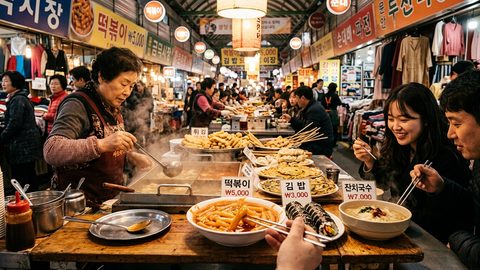 Eating at South Korea's Traditional Markets on Less Than 10,000 Won
Eat well at South Korea's best traditional markets for under 10,000 won. Real dish prices from Gwangjang, Gukje, and Jeonju's Nambu Market.
Eating at South Korea's Traditional Markets on Less Than 10,000 Won
Eat well at South Korea's best traditional markets for under 10,000 won. Real dish prices from Gwangjang, Gukje, and Jeonju's Nambu Market.